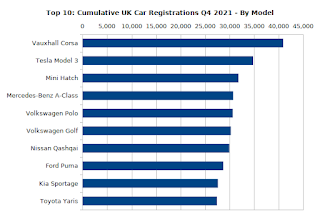
Following a particularly poor March, UK new car registrations for the first quarter of 2022 totalled 417,560 units. That was down by 7,965 versus 2021’s equivalent figure of 425,525.
Nippy performance, great manoeuvrability, diminutive dimensions and zero emissions are qualities that any decent city car needs today. Arguably, a classic Mini running purely on electricity has them all.
2021’s new car registration statistics were markedly different from those of previous years, thanks to supply issues, the ongoing pandemic and changing buying habits.
By the end of the first quarter, it was already evident that new car demand and supply were both going to be severely affected by the pandemic. Indeed, figures just published by the Society of Motor Manufacturers and Traders show a UK registrations total of only 1,631,064 units for the entire year, the worst annual performance since 1992.
Rather optimistically, the latest Best Global Brands report by Interbrand is subtitled ‘A New Decade of Possibility’. On the face of it, such hopefulness might be understandable, given that the total value of the world’s top 100 brands rose by 9 percent year-on-year. However, in these extremely unsettled times, the combined result masks some dramatic ups and downs.
This year saw the worst September for new car registrations since the current bi-annual number plate system was introduced in 1999. Only 328,041 units were retailed, a reduction of 4.4 percent compared to the same month last year.
Commemorating the 56th anniversary of an event is rather random. Nevertheless, Mini has decided that its latest special model should celebrate a famous victory at the 1964 Monte Carlo Rally.
With most car dealers in England reopening during June, registrations have tentatively begun to rise again after a period of enforced stagnation. However, as can be seen from the graph below, 2020’s cumulative total is down by almost a half compared to the same period last year.
As would be expected given the current situation, the first quarter’s new car registration figures are grim reading. An effective shut down of the motor industry’s manufacturing and retailing operations meant that just 254,684 units were sold during the peak month of March, a 44.4% drop compared to 2019.
New car registrations in the UK declined for a third year running during 2019, but the overall reduction was fairly modest. However, as statistics from the Society of Motor Manufacturers and Traders show, buying habits continued to change.
Interbrand has just published its twentieth annual 100 Best Global Brands report. Apple, Google and Amazon continue to occupy the first three slots, but the automotive sector remains well represented.
Figures published by the Society of Motor Manufacturers and Traders show that 343,255 new cars were registered during the important ‘plate-change’ month of September. In other words, there was a modest increase of 4,421 units (or 1.3%) versus last year, but it wasn’t enough to overcome the year-to-date volume deficit.
Ten years after the Mini E research vehicle was created, the production Mini Electric has been launched. The newcomer – which is recognisable by a unique closed grille treatment – is being offered solely in three-door hatchback guise.
Last October, the government announced some big changes to its Plug-in Car Grant. The maximum benefit reduced from £4,500 to £3,500, while tougher eligibility rules meant that plug-in hybrid models could no longer qualify for the subsidy. As expected, the new policies have had an effect on demand.
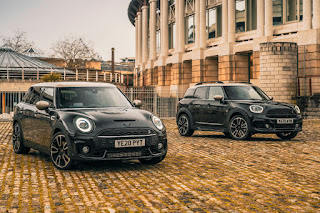
Although Mini is describing the 2019 Clubman as ‘new’, in reality the changes are rather difficult to spot. The most obvious differences are at the front end, where the grille, bumper and LED headlights have been modified.

%20By%20Month.png)
%20Front%20Side.jpg)