Following a particularly poor March, UK new car registrations for the first quarter of 2022 totalled 417,560 units. That was down by 7,965 versus 2021’s equivalent figure of 425,525.
This year’s World Car Awards include a World Electric Vehicle of the Year category for the first time. However, it seems to be somewhat redundant, because all of the top three finalists for the main World Car of the Year prize happen to feature pure-electric powertrains too.
After three rounds of voting, the 2022 North American Car of the Year, Truck of the Year and Utility Vehicle of the Year have been declared. A jury of 50 motoring journalists from across Canada and the United States decided all of the winners.
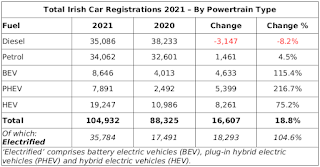
104,932 new cars were registered in Ireland during 2021. Although that figure represented a healthy rise of 18.8% compared to 2020’s total of 88,325, it was still short of the 117,109 deliveries achieved in pre-pandemic 2019.
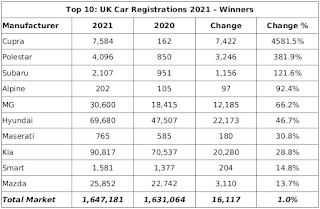
New car registrations in the UK totalled 1,647,181 units during 2021. That figure represented a disappointingly small rise of 1.0% versus the previous year, but some manufactures did manage to significantly outperform the industry average.
2021’s new car registration statistics were markedly different from those of previous years, thanks to supply issues, the ongoing pandemic and changing buying habits.
Electric vehicles dominate the 2022 European Car of the Year finalist list. In fact, six of the seven nominees – which were chosen by a jury vote – feature battery-electric powertrains.
Supply issues caused by the ongoing semiconductor shortage were largely responsible for dismal third-quarter new car registrations in the UK. In fact, 2021’s September performance – just 215,312 units – was the worst since the two-plate-change system was introduced in 1999.
50 motoring journalists from across Canada and the United States have voted to decide the semi-finalists for the 2022 North American Car of the Year, Truck of the Year and Utility Vehicle of the Year awards.
909,973 new cars were registered in the UK during the first half of 2021. Although that total was 39.2% higher than 2020’s corresponding figure, the industry is now experiencing supply problems caused by a global shortage of semiconductors.


%20By%20Month.png)